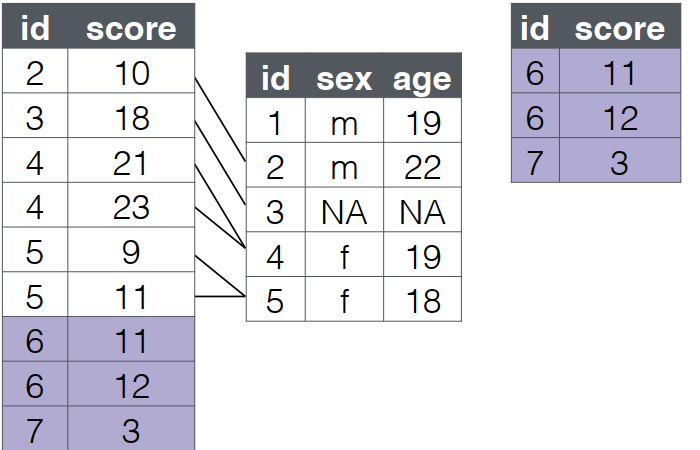
Merging data

National Data Management Center for Health (NDMC) at EPHI


Data mergining

Why Merging Matters in Public Health

  • Combine demographic & clinical data
  • Link longitudinal health records
  • Merge survey responses with medical data
  • Integrate multiple data sources for cohort studies
  • The 4 mutating join verbs:
  • left_join()
  • right_join()
  • inner_join()
  • full_join()
  • The 2 binding join verbs:

  • bind_rows()

  • bind_cols()

  • The 2 filtering join verbs:
  • semi_join()
  • anti_join()
  • All the joins have this basic syntax: *_join(x, y, by = NULL, suffix = c(".x", ".y")

  • x = the first (left) table

  • y = the second (right) table

  • by = what columns to match on. If you leave this blank, it will match on all columns with the same names in the two tables.

  • suffix = if columns have the same name in the two tables, but you aren’t joining by them, they get a suffix to make them unambiguous.

  • This defaults to “.x” and “.y”, but you can change it to something more meaningful.

Sample Health Datasets

  1. Patient Demographics (Synthetic)
Code
library(tibble)
clinic_data <- tibble(
  patient_id = c("P001", "P002", "P003", "P004"),
  age = c(35, 28, 42, 31),
  bmi = c(22.1, 26.5, 29.8, 24.3),
  smoking_status = c("former", "never", "current", "never")
)
  1. Clinical Measurements
Code
lab_data <- tibble(
  patient_id = c("P002", "P003", "P003", "P005"),
  visit_date = as.Date(c("2023-01-15", "2023-02-01", 
                         "2023-03-01", "2023-01-20")),
  sbp = c(120, 135, 140, 128),
  dbp = c(80, 85, 90, 82))

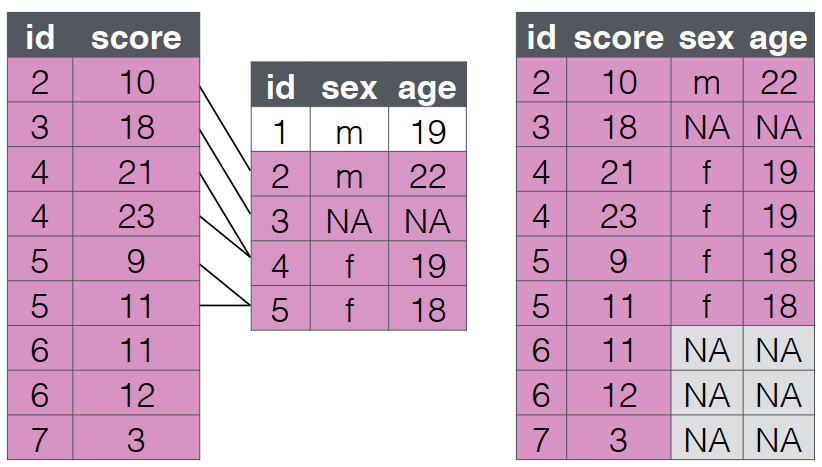
left_join(): Preserve Clinic Records

What it does:

  • Retains all rows from the left (first) table

  • Adds matching columns from the right (second) table

  • Fills NA where no match exists

  • left_joint()

Code
library(dplyr)
left_join(clinic_data, lab_data, by = "patient_id") %>% 
  arrange(patient_id) %>% head(4) 
# A tibble: 4 × 7
  patient_id   age   bmi smoking_status visit_date   sbp   dbp
  <chr>      <dbl> <dbl> <chr>          <date>     <dbl> <dbl>
1 P001          35  22.1 former         NA            NA    NA
2 P002          28  26.5 never          2023-01-15   120    80
3 P003          42  29.8 current        2023-02-01   135    85
4 P003          42  29.8 current        2023-03-01   140    90
  • Merging patient registries with lab results

  • Preserving all patients from primary clinic records
  • The order of the clinic_data and lab_data tables is different.
Code
left_join(lab_data, clinic_data, by = "patient_id") %>% 
  arrange(patient_id) %>% head(4)  
# A tibble: 4 × 7
  patient_id visit_date   sbp   dbp   age   bmi smoking_status
  <chr>      <date>     <dbl> <dbl> <dbl> <dbl> <chr>         
1 P002       2023-01-15   120    80    28  26.5 never         
2 P003       2023-02-01   135    85    42  29.8 current       
3 P003       2023-03-01   140    90    42  29.8 current       
4 P005       2023-01-20   128    82    NA  NA   <NA>          
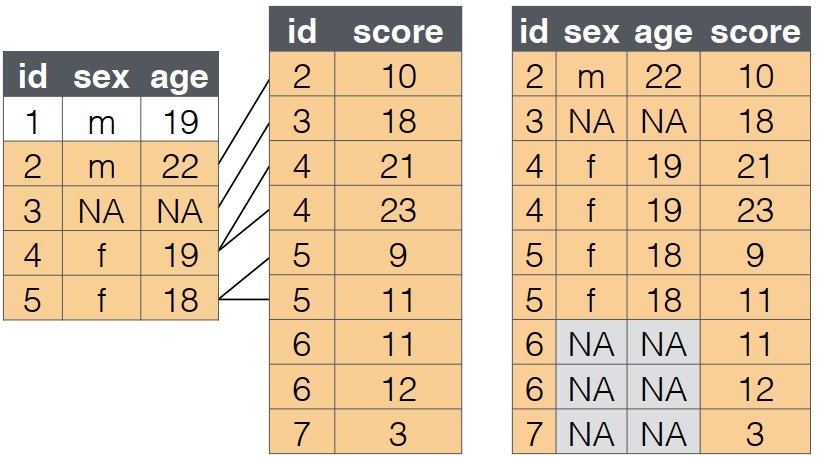
right_join()

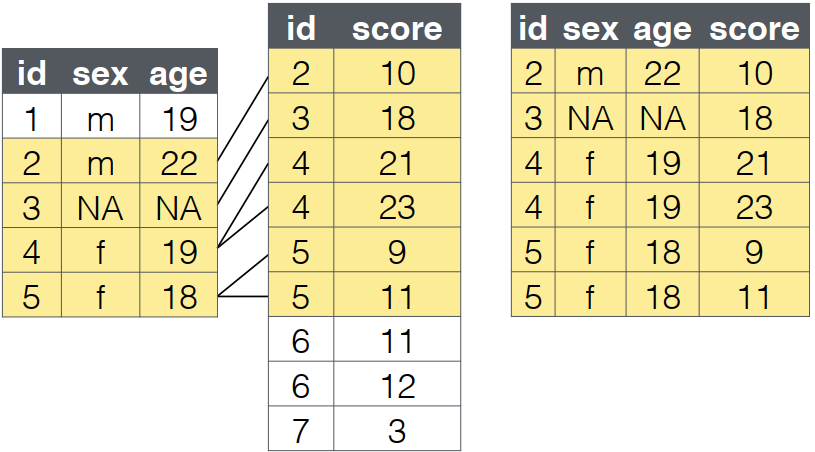
  • A right_join keeps all the data from the second (right) table and joins anything that matches from the first (left) table.
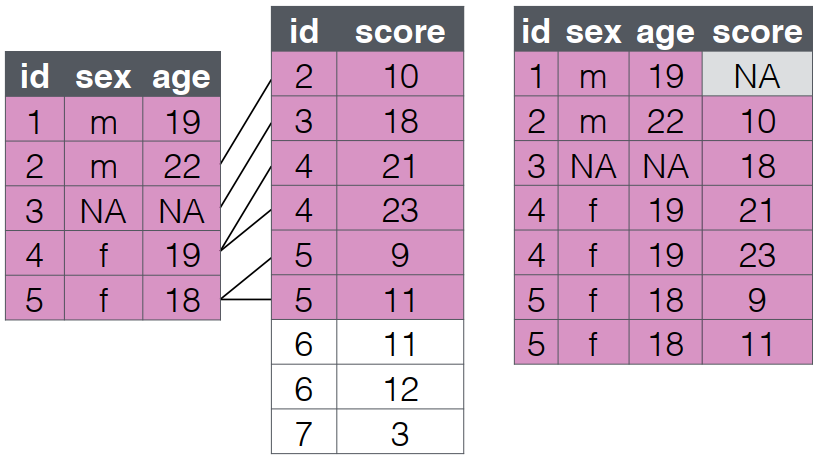
inner_join(): Complete Cases Only

What it does:

  • Returns only rows with matches in both tables
  • Filters out non-matching records
  • An inner_join returns all the rows that have a match in the other table.
Code
inner_join(clinic_data, lab_data, by = "patient_id") %>% 
  knitr::kable()
patient_id age bmi smoking_status visit_date sbp dbp
P002 28 26.5 never 2023-01-15 120 80
P003 42 29.8 current 2023-02-01 135 85
P003 42 29.8 current 2023-03-01 140 90
  • Creating analysis datasets with complete information
  • Identifying patients with both survey and clinical data
full_join()

What it does:

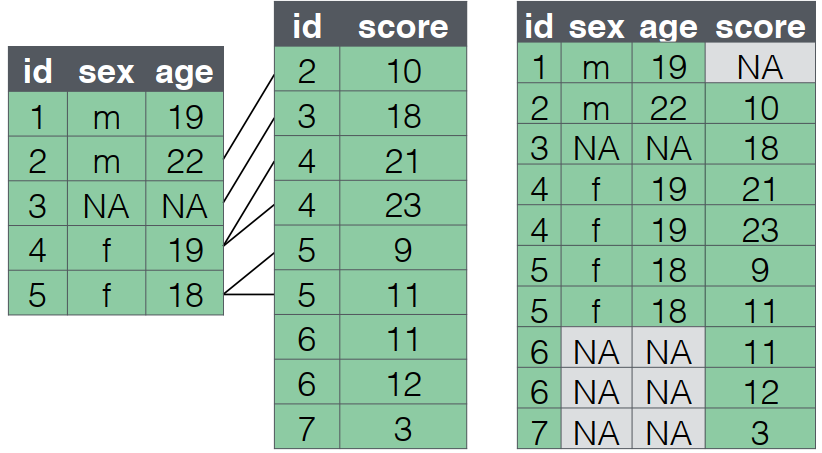
  • A full_join lets you join up rows in two tables while keeping all of the information from both tables.
  • If a row doesn’t have a match in the other table, the other table’s column values are set to NA.
Code
full_join(clinic_data, lab_data, by = "patient_id")
# A tibble: 6 × 7
  patient_id   age   bmi smoking_status visit_date   sbp   dbp
  <chr>      <dbl> <dbl> <chr>          <date>     <dbl> <dbl>
1 P001          35  22.1 former         NA            NA    NA
2 P002          28  26.5 never          2023-01-15   120    80
3 P003          42  29.8 current        2023-02-01   135    85
4 P003          42  29.8 current        2023-03-01   140    90
5 P004          31  24.3 never          NA            NA    NA
6 P005          NA  NA   <NA>           2023-01-20   128    82
semi_join()

  • A semi_join filters left table to rows with matches in right table
  • Keeps only left table columns
Code
semi_join(clinic_data, lab_data, by = "patient_id")
# A tibble: 2 × 4
  patient_id   age   bmi smoking_status
  <chr>      <dbl> <dbl> <chr>         
1 P002          28  26.5 never         
2 P003          42  29.8 current       
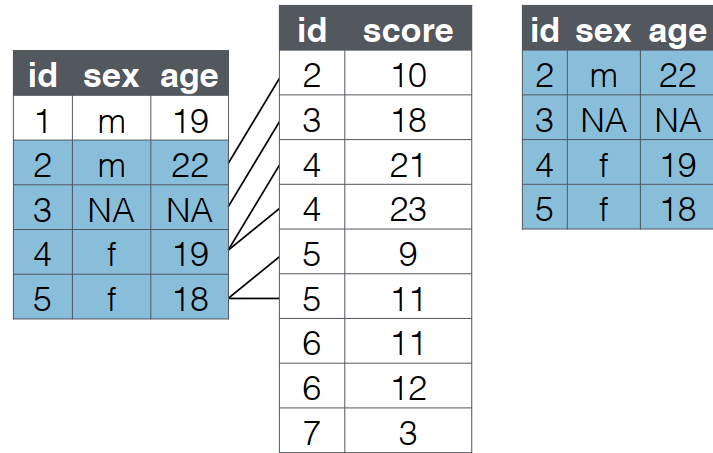
  • Here in this data case: Find patients with lab results

anti_join(): Identify Missing Data

  • A anti_join() return all rows from the left table where there are not matching values in the right table, keeping just columns from the left table.
  • anti_join().
Code
anti_join(clinic_data, lab_data, by = "patient_id") %>% 
  knitr::kable()
patient_id age bmi smoking_status
P001 35 22.1 former
P004 31 24.3 never
  • In this data case: Identify patients needing follow-up ::: {style=“text-align:center”}
  • Order matters in an anti_join().
Code
anti_join(lab_data,clinic_data, by = "patient_id") %>% 
  knitr::kable()
patient_id visit_date sbp dbp
P005 2023-01-20 128 82

:::::::

Find patients needing follow-up lab tests

Real-world Example: Birth Weight Analysis Birth Weight Data (MASS::birthwt)

Code
birthwt_modified <- MASS::birthwt %>%
  mutate(
    patient_id = paste0("M", 1:n()),
    low = factor(low, labels = c("Normal", "Low")),
    smoke = factor(smoke, labels = c("Non-smoker", "Smoker"))) %>%   
  select(patient_id, low, age = age, weight = lwt, smoke)

Postnatal Follow-up Data (Synthetic)

Code
followup_data <- tibble(
  patient_id = c("M12", "M15", "M42", "M88"),
  infant_weight_6mo = c(7.2, 6.8, 7.5, 6.9),
  breastfeeding_duration = c(6, 5, NA, 4))
  1. full_join(): Comprehensive Birth Cohort
  • Combine prenatal and postnatal data for longitudinal analysis
Code
right_join(birthwt_modified, followup_data, by = "patient_id") %>% 
  select(patient_id, low, smoke, infant_weight_6mo)  %>% 
  knitr::kable()
patient_id low smoke infant_weight_6mo
M12 Normal Non-smoker 7.2
M15 Normal Smoker 6.8
M42 Normal Non-smoker 7.5
M88 Normal Non-smoker 6.9
  1. semi_join(): Smoking Mothers with Follow-up
  • Identify smoking mothers in follow-up program
Code
birthwt_modified %>% 
  semi_join(followup_data, by = "patient_id") %>% 
  filter(smoke == "Smoker") %>% 
  knitr::kable()
patient_id low age weight smoke
100 M15 Normal 18 100 Smoker

bind_rows()

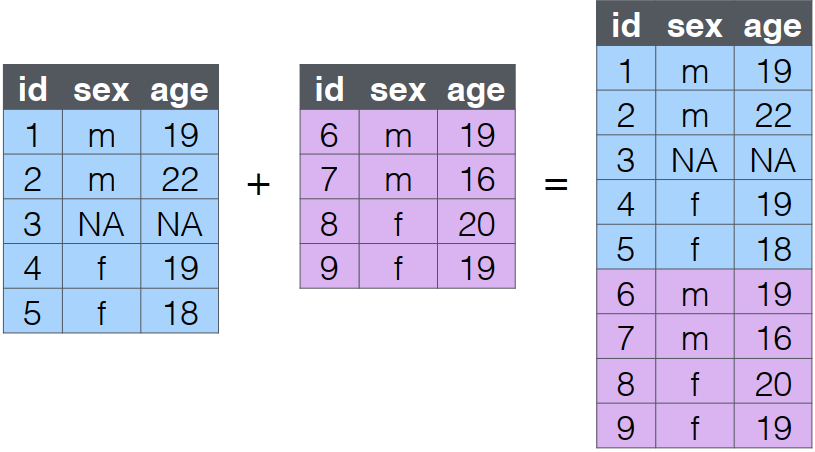
  • You can combine the rows of two tables with bind_rows.
  • Here we’ll add subject data for subjects 6-9 and bind that to the original subject table.
Code
new_patients <- tibble(
  patient_id = c("P4", "P5"),
  age = c(55, 38),
  smoking_status = c("Never", "Current")
)

bind_rows(clinic_data, new_patients)
# A tibble: 6 × 4
  patient_id   age   bmi smoking_status
  <chr>      <dbl> <dbl> <chr>         
1 P001          35  22.1 former        
2 P002          28  26.5 never         
3 P003          42  29.8 current       
4 P004          31  24.3 never         
5 P4            55  NA   Never         
6 P5            38  NA   Current       
Code
bind_rows(subject, new_subjects)

  • The columns just have to have the same names, they don’t have to be in the same order.
  • Any columns that differ between the two tables will just have NA values for entries from the other table.

  • If a row is duplicated between the two tables (like id 5 below), the row will also be duplicated in the resulting table.